Springboro Area Yesterday:
A Pictorial History
Rebecca Hall, ed



Springboro Area Yesterday:
A Pictorial History
Rebecca Hall, ed



“Springboro has never had the advantages to be derived from a railroad connection with the outside world,” bemoaned Jessie Wright in his 1915, centennial address for the village. “Let us hope that Springboro may yet get on the map…the railroad map.”

Were Jesse Wright to return to his hometown today he may be surprised to find the flourishing community which exists in spite of an absence of the hoped-for railroad. The tiny village founded on the banks of Clear Creek in 1815, by his grandfather, Jonathan, now sprawls into two counties, Warren and Montgomery, in beautiful southwest Ohio. The Springboro Area Historical Society preserves Jessie’s words and spirit in its dedication to the unique heritage of its ancestors. The historical society came together in 1992, to save the 1798, Christian and Charles Null cabin located on what is now Heatherwoode Golf Course and its work continues with preservation and education efforts throughout the community.
A commemorative history, edited by Rebecca Hall, was published for the sesquicentennial in 1965, and in the 2003, Springboro Area Yesterday: A Pictorial History, a wonderful survey of the people and landscapes of the area, was produced by the City of Springboro Historic Commission in cooperation with historical society and edited by Rebecca Hall.
The museum offers a selection of local history and genealogy reference materials, maps of the city, township and county, and an large collection of artifacts and pictures.
Residents share the Society’s pride in their community; since 1915, they have come together every Memorial Day, Fourth of July and Labor Day to parade through the historic streets of the old town.
Springboro’s founder, Jonathan Wright, followed his father, Joel, to the Miami Valley in 1814. The Wrights and perhaps a dozen other Quaker families came from their home in Pennsylvania, journeying along the Ohio River up the Little Miami River to Waynesville and nearby Springboro where they found clear, abundant water.
Jonathan Wright settled on the banks of Clear Creek, west of the earlier settlement, and in 1815, platted “Springborough.”
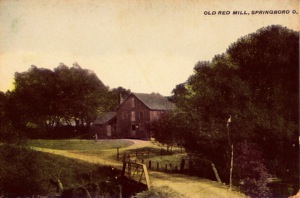
By 1840, 417 residents called Springboro home, with names such as Null, Stanton, Frey (Frye), Greggs, Crocketts and Mullins, joining the Wrights on the town roster.
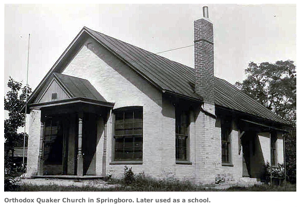
Methodist Episcopal, Universalist, German Reformed and Presbyterian churches followed in short order.
The county has never been at a loss for religious sentiment with over 60 churches established by 1850, and many of the faithful soon moved on to found schools. Francis Glass is noted as the first school teacher, beginning in 1816, and by the mid 1800s, ten schools were scattered throughout the township serving 750 students. The Springboro Special School District opened in 1837, with lessons in English, mathematics, science and Latin.
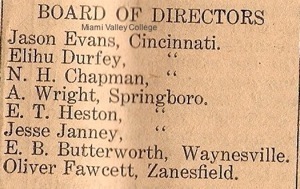
Aron Wright served as president for nine years before returning to New York state; unfortunately, the college did not long outlast him and its doors closed in 1883.
For more informal pursuits, residents turned to the Springboro Library Association, founded in 1832, at the corner of Market and Main Streets, where librarian and town physician Dr. Joseph Stanton presided. The Grange, Masons, Knights of Pythias, United American Mechanics and the Oddfellows offered philanthropic and social outlets for the gentlemen. Book Regular lectures and numerous book clubs informed and entertained local residents. Jessie Wright reports with some relish possessing the journals of a “mock Legislature” which met from 1841-45, for a “profitable form of amusement during the long winter evenings,” including drama and debates.
Springboro’s Quaker roots remained strong. From its founding, when Jonathan Wright parceled lots to new settlers, a deed restriction prohibited the sale of whiskey on the land for a period of ten years. However, thirsty travelers were not without respite; Wright’s property ended at North and Franklin Streets and ingenuity led to all the taverns being located north of that line in “Carr’s Addition.” Jessie’s centennial address also notes “no less than fifteen distilleries” in a two mile radius of the village in its early days. The Women’s Christian Temperance Union, a force to be reckoned with throughout the county, succeeded in keeping liquor sales out of Springboro for over forty years in the late 1800s.
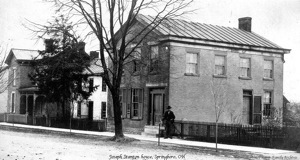
In 1999, Springboro erected the first municipal Underground Railroad Historic Marker and the city of Springboro participates in regular celebrations of its special place in a turbulent period of our national history.
Springboro’s population grew steadily at the turn of the twentieth century. Farmers from many of the nearly three hundred local farms moved to town in their later years looking for an easier life. By 1880, Beers’ History of Warren County listed Springboro census at 553. The next 100 years saw the town balloon to 12,380 (2000 census). The Springboro Community City School District has grown from an estimated 200 students in 1880 meeting in a single building at East and Market Streets to 5,500 students in nine buildings spread throughout the community. A new city hall and police department was inaugurated in 2009, at 320 West Central to afford local government sufficient space to meet the demands of the growing community. A Strategic Master Plan was developed in the late 1990s and another ten years later in an effort to better oversee city expansion as local officials struggle to make that dream a reality with an updated Land Use Master Plan in early 2009.
For a town the railroad left behind, Springboro has done well indeed, and the people of Springboro remain committed to recording its history – and its progress – for years to come.
References:
“A Time to Look Back.” Bicentennial Supplement to The Western Star. 30 June 1976. (MFH)
(The) History of Warren County. Chicago, Illinois: W.H. Beers & Co., 1882.
Springboro Area Yesterday: A Pictorial History. Rebecca Easton Hall, ed.
City of Springboro website. < http://www.ci.springboro.oh.us/index.aspx>
Springboro Community City School District website.

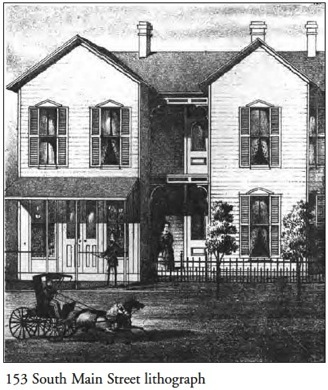
In 2000, the City of Springboro completed their study and creation of Springboro’s Historic Design Standards (pdf). Though oriented towards preservation of our historic buildings through design standards, a good deal of the history of Springboro and the history of architecture, design and construction is included in the one hundred twenty-eight page report.
The house to left is on the northwest corner of S. Main St and Market St. and was built around 1858, by James P. Griffin, a druggist. The outlines of the house can still be seen behind the commercial facade. Later, William H. Newport, a dry goods merchant, lived there, and it was then occupied from 1892-1910, by Joseph M. Bunnell, a grocer, per Rob Strawser’s Yesterday, Historic Properties in Springboro, Historic Homes, Property Sales and Transaction in Olde Springboro and Surrounding Lands.)

© 2011-2022