Merger of the Evangelical United Brethren Church and Springboro Methodist Church



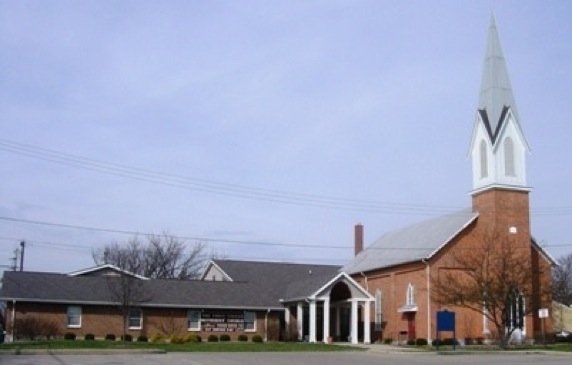

The United Methodist Church was created on April 23, 1968, when The Evangelical United Brethren Church and The Methodist Church united to form a new denomination.
The Springboro United Methodist Church is preparing to celebrate its bicentennial in Springboro. If you have any history of the congregation, please share it.
Methodism dates back to 1736 and the leadership of John and Charles Wesley.United Methodists share an historic connection to other Methodist and Wesleyan bodies.
The Brethren Heritage Center is located in nearby Brookville, Ohio and is dedicated to preserving historical and current information concerning the various Brethren bodies which have a rich heritage dating to 1708 in Schwarzenau, Germany. Southwestern Ohio was chosen for the location of the center due to the large number of Brethren living in the Miami Valley Region.

HISTORY
of the
EVANGELICAL UNITED BRETHREN CHURCH
Springboro, Ohio
March 19, 1950
Mrs. C. W. (Elva) Allen
(Written on the occasion of the merger of Springboro’s EUB Church and the Methodist Church,)
Members of the Evangelical United Brethren Church, members of our sister churches of the town and friends of this community; We come today humbly, yet with thanksgiving in our hearts, and praise to God for His goodness and mercy, and hope for the fulfillment of our goal in the very near future.
I was given the task of bringing some of the church history to you, certainly not because of any ability, but perhaps because our family was one of the oldest in the church and is now of the fifth generation that has been connected with the United Brethren Church in this community. It was here, too that the ancestors of Vera Blin, who poured out her life in the cause of missions and was known throughout the church at large, worshipped.
The Fry family dates back to the same period of time and we have children in the Sunday school today of the sixth generation of the Fry family. Many other names found in the old church records are Antrim, Miller, Eyer, Easton, Null, Miltenberger, Bell, Fox, Merritt, etc. Just how long this group of United Brethren people met and worshipped in the homes is not known, but they recognized their need for a church building, remembering the place in the scripture which says, “Neglect not the assembling of yourselves together.”
The old records tell us that on November 19, 1822, a parcel of land was bought from Adam Null of Warren County, State of Ohio, for the sum of $20.00 and that on December 14, 1822, a smaller parcel of land was bought from Henry Bowser and wife Fanny of Warren County, State of Ohio for $0.75. The land is located southeast of Springboro on the Null Road where the little graveyard still remains. The Trustees of the church who made this purchase were Henry Joseph Fry, Christian Null, (Christopher) Christian Blin and John Phillip Fry. Henry Joseph Fry was believed to have come from Germany to Loudown Co. Virginia. Later, in 1816, he came to Ohio. He was a well-educated man, a physician, also a minister of the gospel in the United Brethren Church, and did much ministerial work, preaching both in the German and English languages.
Christian Blin’s father, Adam Blin, immigrated to America from Germany, and not having any money for his passage, was sold. After serving for three years he was a free man and came to Warren County, Ohio. These two men, Henry Joseph Fry and Christopher Blin were outstanding church and community leaders.
A log church was erected on the land purchased and served as a place of worship for a number of years. Then the people began to think in terms of a new and better church. I have a record of a meeting held March 22, 1841, which reads as follows: We the subscribers promise to pay the sum annexed to our names for the purpose of building a brick meeting-house, 40 ft. long and 30 ft. wide to be finished in plain style, with free seats, for the Church of the United Brethren in Christ, on the lot where the old meeting house stands, near Taylor Tanyard, Clearcreek Township, Warren County, Ohio. A true copy of the original signed as follows. There were forty-two names signed to this paper with the amount of their pledges; the pledges ranging from $1.00 to $60.00, the total amount $480.00. The brick church was built soon thereafter.
On December 25, 1847, the class met at the Clearcreek Chapel at the hour of eleven o’clock, read a chapter, sang a song, and had a prayer, and then proceeded with the business of planning to erect a fence around the graveyard and meeting house.
There was a resolution passed the class that the fence is to be made of walnut or pine and the boards is to be one inch thick and the length of the boards is to be from 12 ft. to 16 ft. long, no less than 12 ft. and no more than 16 ft. and the posts is to be sweet oak, and if they can’t be had, then takes burr oak, and the posts is to be 5 in. square at the bottom and 5 in. by 3 in. at the top, and the posts is to be 7 ft. long and four posts for the gates and they are to be straight with the meeting house fence, and there is to be a fence between the graveyard and the meeting house and the fence is to be made like the outside fence and there is to be a gate made, and the three gates is to be 4-1/2 feet wide.” Christian Blin was made Collector and Treas. for the fence around the dooryard and graveyard. There followed a list of names and pledges for the cost of this fence.
Again assembling at the Clearcreek Chapel in 1860, it was resolved that it was necessary for the church to be incorporated according to the laws of the State of Ohio made and provided for such societies. On motion it was resolved that the church society at Clearcreek be known as the United Brethren in Christ. From the Board of Trustees, Jacob Fry, George Blin, and David Antrim, George Blin was appointed chairman and Jacob Fry, Clerk. This application for incorporation was recorded June 14, 1860.
Some years later the people were again thinking in terms of a new church, this one to be built in Springboro. The membership at this time was about 112. On April 30, 1873, the trustees, Christopher Blin, John C. Miltenberger, Grafton Bell, John Antrim, and William Langdon bought the present site for the sum of $500.00 from John Hadley of Warren County, Ohio.
They built this present church in 1874, using the brick from the old church in the country for the inside walls and brick for the outside walls was burned on the farm where Mr. and Mrs. Charles Hartman now live on Route 73, west of Springboro. On April 27, 1875, the Ministerial Association of the Miami Conference held its 42nd Session in the Springboro Church.
On August 22, 1877, about seventy-three years ago, the 68th Session of the Miami Conference of the United Brethren in Christ convened at Springboro. In his report at the conference, the presiding elder, C. J. Berkert, said that the Springboro mission through the energy of the pastor, J. C. Miller, and seconded by the help of the good brethren, nearly one thousand dollars was secured for the liquidation of church indebtedness. Utica and Springboro were free of debt and Oregonia (or Freeport, as it was then called) was fully subscribed. At this time, the Springboro circuit was comprised of Springboro, Utica, Harveysburg and Oregonia. Rev. Miller who was the pastor, lived at Vandalia and served these four churches and used a horse and cart for transportation.
Some notes were taken from the Conference Minutes at Springboro say that the sessions opened at 8:30 A.M. for the morning session and at 2 P.M. for the afternoon for four days. Evening services were not held until Saturday. On Sunday, an experience meeting was held in the conference room at 9 A.M. At 10:30, Bishop Dixon preached the conference sermon for the 16th Chapter of Acts, after which Rev. S. F. Coons was solemnly ordained as an elder in the church. At 3:00 P.M. a children’s Meeting was held. Addresses were delivered by E. S. Chapman, D. Berger, and Brother R. Cowden. This service was entertaining and was highly enjoyed by the children. At 7: 30 P.M., Rev. E. S. Chapman preached to a large congregation from the Song of Solomon 2:16, “My Beloved in mine and I am His”, after which the sacrament of the Lord’s Supper was administered.
The following pulpits were supplied on the Sabbath by members of the Conference: Methodist Episcopal Church at Springboro, Rev. J. P. Landis, 10:30 A.M., Rev F. G. Grisly, at 7:30 P.M.; Reformed Church, Springboro, Rev. J. L. Swain, 10:30 A.M. , Rev. S. M. Hippard, 7:30 P.M.; Methodist Episcopal Church Red Lion, Rev. W. T. Osborne, 10:30 A.M. Rev. Wm. M. Beardshear delivered an address for the Christian Temperance Union at Franklin on Sabbath evening in the Methodist Episcopal Church. The sessions throughout were pleasant, a fervent Christian feeling pervaded many hearts.
A report taken from a Sunday School record of 72 years ago in 1878, reads as follows: Sunday School opened by Supt. Christopher Blin, a hymn was sung, J. C. Miltenberger read the scripture, prayer by Thomas Bell. The lesson was the “Captivity of Judah”. There were 81 scholars and teachers present and six visitors. The amount of the collection was $0.99. Signed: C. A. Miltenberger, Secretary. Balance in Treasury, $2.24. A. Easton, Treasurer. Pleasant weather.
On the 13th of August, 1892, the Trustees, James C. Merritt, George Fox, and Thomas Bell bought our first parsonage for $800.00 from Elmer E. Crockett, the duly appointed administrator of the estate of Mary E. Guest, deceased.
On April 3, 1942, the Trustees, Harold Mills, Charles Allen, Harry Fry, Ralph Mills and Charles Harris bought our present parsonage on lots 23 and 25 of Mrs. Mary Rosnagle for $2,500.00.
It was necessary to have our church re-incorporated under the present state laws and this was done April 17, 1942. A yearly report is to be files with the Secretary of State by an agent of this corporation. R. R. (Ralph) Mills, consented to serve in this capacity.
On August 29, 1942, the trustees sold our former parsonage to Walter and Cora Apgar for $2,000.00.
Looking forward to a new furnace and some remodeling, we started a Building Fund some years ago.
Some 12 years before the final merger was actually accomplished on November 16, 1946, the Evangelical Church and the United Brethren in Christ began re-studying the possibilities of uniting as one denomination. After this was completed, the two churches are now known as the Evangelical United Brethren Church.
Student pastors have served this church almost entirely for about 45 years. Our first student pastor, Rev. J. E. Paddock, came to us in 1905, followed by Rev. G. L. Stine. Many other students have served here. Among them are Rev. Wade Miller, Ralph Knight, Donald App, L. L. McCormick, Robert McCannon, A. E. Benedict, Rev. Miller, and others.
Rev. Gale L. Barkalow, our present pastor, has been with us all too short a time, working faithfully and untiringly, patient with out failures and shortcomings, and ever striving to lead us to a higher plane of Christian living. He has helped us work and plan throughout his ministry in every way possible in every department of the church and our Board of Trustees, Harold Mills, Allen D. Fry, Earl Fry, Howard Stitzel, and Oral Saunders, for this day. The time has come when the actual work will begin very soon. We hope and pray this church will still live in the hearts and lives of its people, and the people of the community, that it may serve them in the future in a larger way, as it has done in the past, in sickness and health, in joy and sorrow, through trouble and death. And let us all not forget, some one has said, persecution has not crushed the church, power has to beaten it back, time has not abated its forces, and what is most wonderful of all, the abuses of its friends have not shaken its stability. The church may have seen its duty imperfectly, for it is made up of fallible things, but when all is said, it has been the one power through nearly two thousand years which has stood for peace, for brotherhood, and for the cause of the poor and distressed. May God bless all Christian Churches everywhere this day.
***
(The above historical account was prepared by Mrs. C. W. Allen at the request of the Council of Administration and was presented at the Ground-breaking Service, Sunday, March 19, 1950.)
***
HISTORY OF THE PRESENT BUILDING PROGRAM
The following dates and facts were presented by Mr. Harold Mills, member of the Board of Trustees, who has been closely associated with the Building Project from its beginning:
1939
The Church needed interior decoration, but it was decided that it would be a waste
to decorate before doing other things.
Oct. 5, 1940
The F.T.V. Class voted to dig a furnace room under the church. Investigation
revealed it would cost $1100. It could not be then done.
June 8, 1941
The Building Fund was started. Weekly offerings were taken until April 26, 1942.
March 23, 1942
Exchange of parsonages was authorized, from the one of Franklin St. to the present
one, adjacent on the west to the church.
1943
Interior of church decorated.
April 1947
Architectural Drawings made and presented by architect. Cost exceeded
expectations and it was decided to defer action.
January 1948
Building Fund Weekly Offerings were discontinued, due to the decline in interest.
1948
Council approved installation of heating system and appointed Committee for this
purpose. The Committee felt that additional facilities should go along with the new
heating system due to increased attendance.
Aug. 21,1949
Council of Administration voted to build an addition to the west side of the church
with specific architectural plans stipulated and to install a heating system.
Sep. 6, 1949
The above action passed the Congregational Meeting.
Sep. 1949
Approved by Board of Missions, Miami Conference.
Nov. 13, 1949
Pledge Day with results totaling $2,245.40, lump sum and weekly pledges.
Mar 13, 1950
Ground-breaking service.
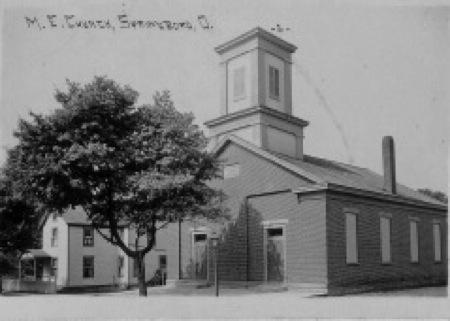
ME Church, c 1925

© 2011-2022